What is a Catamaran?
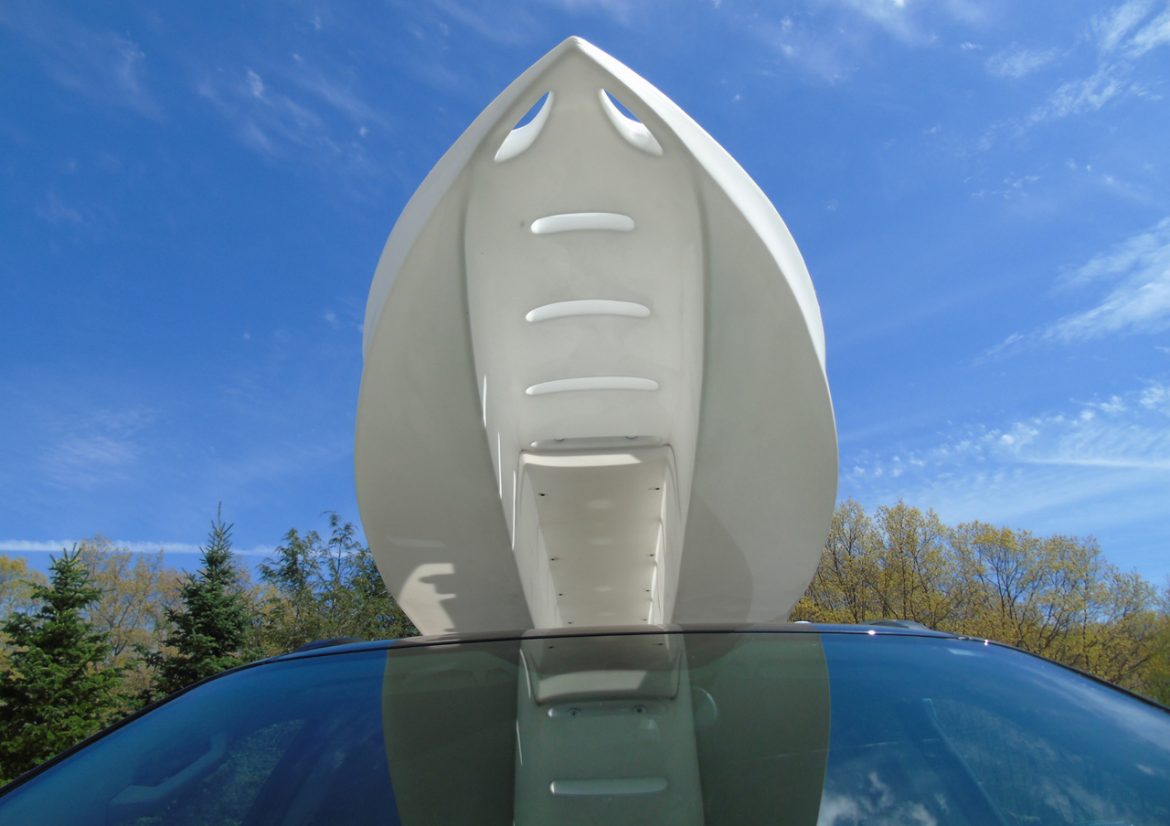
Definition: A Catamaran, a.k.a. ‘Cat’ is a twin hulled watercraft that features two slender, parallel hulls of equal size, and an upper structure that holds them together at a distance from each other. This structure makes the typical catamaran a geometry-stabilized craft, that derives its lateral stability from its wide beam and the distribution of its buoyancy along its sides.
The catamaran’s two hulls combined often have a smaller hydrodynamic resistance than monohulls of comparable size, and therefore require less propulsive power.
Catamarans range in size from small sailing boats and motorboats to large ships and ferries. The structure connecting a catamaran’s twin hulls can vary from a simple, lightweight frame to a bridging superstructure, namely deck from which the catamaran is operated, and can be used for carrying freight and passengers.
Are the Wavewalk 700 and S4 Catamarans?
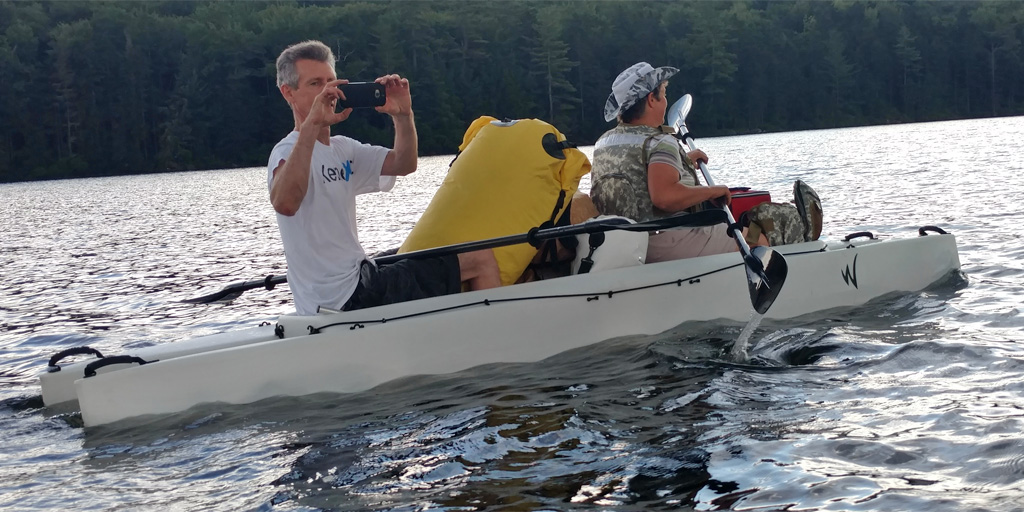
Both these Wavewalks are catamarans since they feature two distinctive hulls, but they are not catamarans in the traditional sense: The Wavewalk design is based on a proprietary (patented) invention – a new type of small watercraft. This patent is entitled “Twin Hull Personal Watercraft”, which is revealing of the fact that a Wavewalk is meant to serve one person, or a small number of persons, and closely interact with them. A Wavewalk is designed around the person and for that person, and it offers them the optimal means to balance themselves. Wavewalk and user are an integrated system that can achieve the most stability in a watercraft of similar size and even bigger ones.
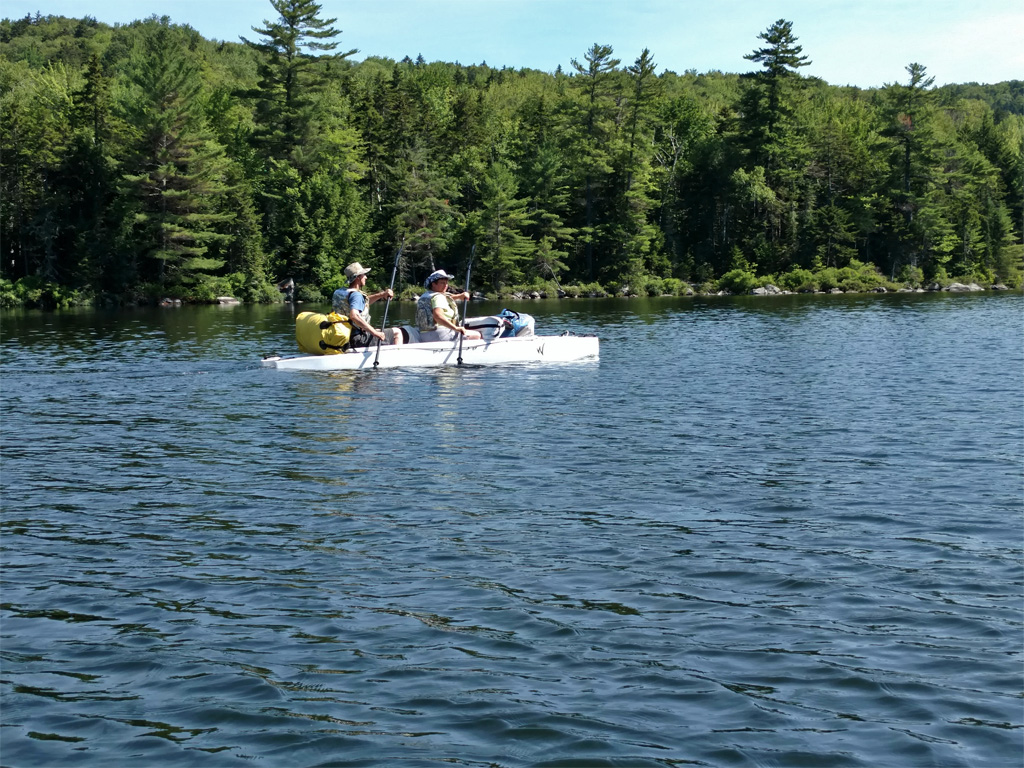
Unlike a typical catamaran, a Wavewalk is narrow – It is slightly wider than its operator, similarly to typical monohull paddle craft such as kayaks and canoes.
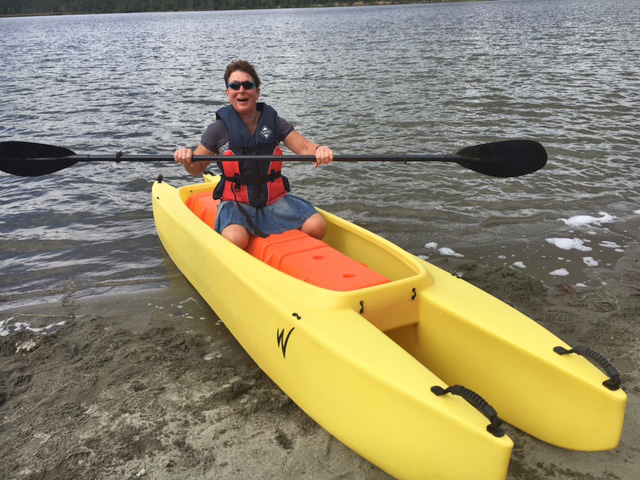
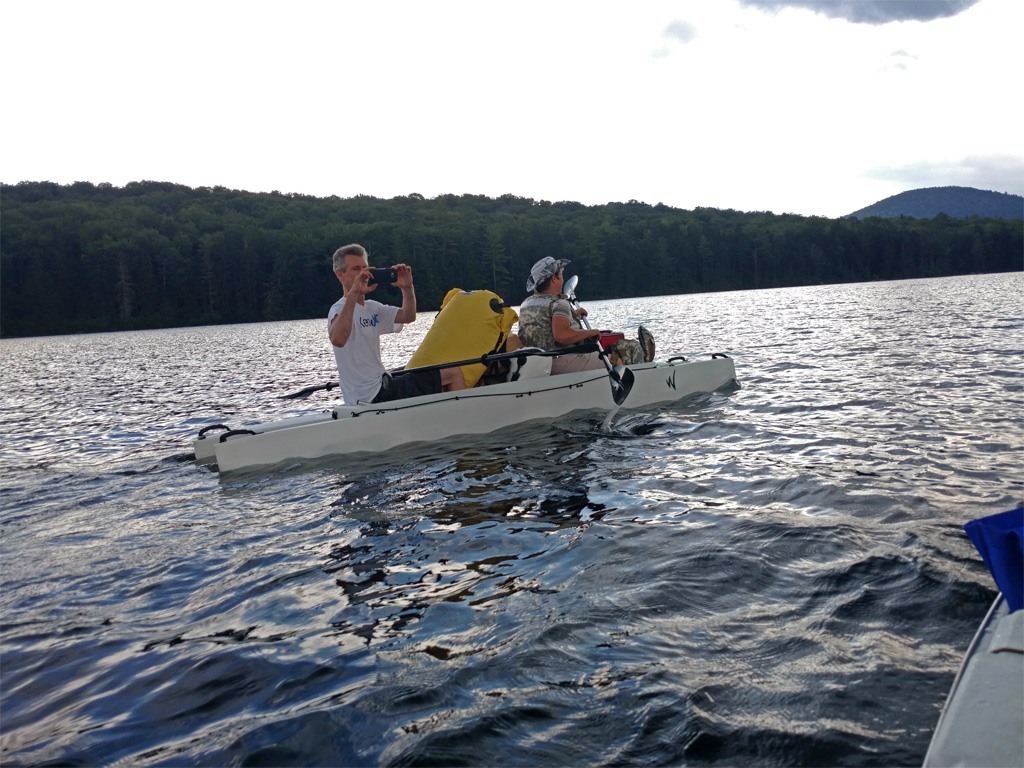
The user of a Wavewalk operates the boat neither from one of its hulls nor from the top of a deck-like structure that bridges the hulls of a classic catamaran. Instead, the Wavewalk user operates it from within, with a leg in each of the boat’s two hulls. The user’s feet rest firmly on the bottom of the hulls, below waterline, namely as low as possible.
And this is the main difference between a Wavewalk and a typical, wide catamaran – The Wavewalk is a smaller and narrower watercraft whose design offers a hull for each of its user’s legs, combined with a longitudinal saddle seat, as means for them to balance themselves effortlessly, intuitively, and with the maximum effect.
In sum, the Wavewalk is different from a typical catamaran in that it is not a pure form-stabilized boat, but one that combines more than one feature and approach in order to maximize stability*
Another difference between the Wavewalk and a typical catamaran is the form of the structure that connects its twin hulls. This structure is called the Saddle, because it resembles the type of seat found in personal watercraft (PWC) a.k.a. ‘Jet-Ski’, snowmobiles, and all-terrain vehicles (ATV), all of which are high-performance personal vehicles.
If it’s a catamaran, can the Wavewalk be a kayak, a boat, or a PWC?
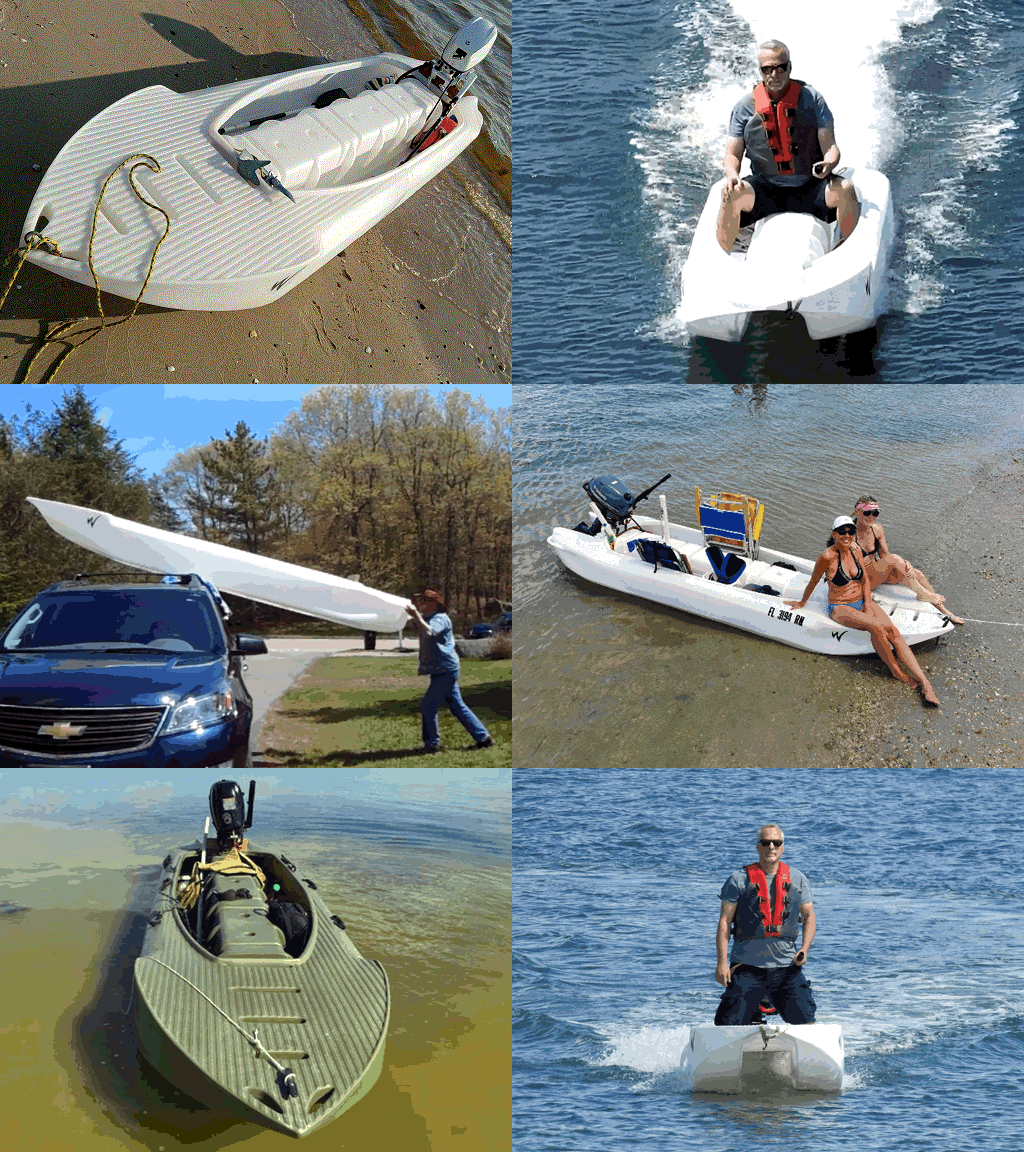
Thanks to the fact that the S4 features two totally distinct catamaran hulls, the authorities, namely the US Coast Guard, officially classify the Wavewalk S4 as a Multihull Boat. The reason the S4 is classified as a boat and not a kayak is the fact that Wavewalk, its manufacturer, set the max recommended power for it to 6 HP, which is beyond the power range allowed for motorized kayaks its size.
However, the W700 is classified as a kayak because Wavewalk set the maximum recommended power for it to 3 HP, which is within the range allowed for kayaks its size.
The Wavewalk design is considerably more stable than kayaks are, including the wide fishing kayaks. It tracks better than kayaks, and paddles infinitely better in strong wind, which is why it does not require a rudder. The Wavewalk also offers much more storage space.
But most importantly, unlike monohull kayaks that force their users to paddle seated in the notoriously uncomfortable L posture, the Wavewalk is back pain free, since it offers it users to comfortably ride its ergonomic saddle, with a leg on each side of their body.
The unique combination of maximal stability and better ergonomics makes the Wavewalk such a perfect match for a motor.
A personal watercraft (PWC)?
Riding the saddle of a motorized Wavewalk® S4 at a speed of 17 mph is an exhilarating sensation that may remind the driver of a PWC, but the latter type of watercraft features much more powerful engines, and can go much faster than the S4. Additionally, PWC are designed for instant full recovery in case they capsize and their user survives… which is not the case with a motorized Wavewalk.
A boat?
Even a small boat is still much wider than a kayak, or canoe, which is why it’s practically impossible to paddle a boat to any meaningful distance. This extra width gives a boat a significant stability advantage over kayaks and canoes, and typically, a normal size person can stand on one side of a boat without tipping over.
But a normal size person can do this in a Wavewalk® 700 too, and this unique fact places the Wavewalk® 700 in a class of its own – a kayak that offers the stability of a small boat.
Motorized, a Wavewalk® 700 offers the stability performance of a small boat, on top of its unique and unrivaled performance in terms of mobility, comfort, storage space, etc. As for the S4, it is considerably more stable and seaworthy than other boats of similar size.
What about A canoe?
Canoes can be very big, and transport up to dozens of passengers. The popular North American recreational canoes that measure up to 17 ft in length can take 3 to 4 adult passengers on board.
While Wavewalks work perfectly with single-blade (canoe) paddles, both solo and in tandem, they can carry less payload than large size canoes do. However, a Wavewalk tracks better than a canoe does, and unlike canoes, it is easy to paddle in strong wind.
… and a motorized canoe?
A motorized square-stern canoe performs much like a lightweight dinghy, and as such it doesn’t work very well as a dedicated paddle craft, namely a canoe…. In addition, it is usually less stable than a typical dinghy, which is wider.
Thanks to its slender, parallel twin hulls, the Wavewalk® 700 tracks better than a motorized canoe, it’s more stable, and being narrower it paddles better as well.
Driving a Wavewalk® 700 is easier too, thanks to the ergonomics of its saddle, and the fact that the motor is located closer to the middle of the boat, away from its stern, which improves balance.
Skiff?
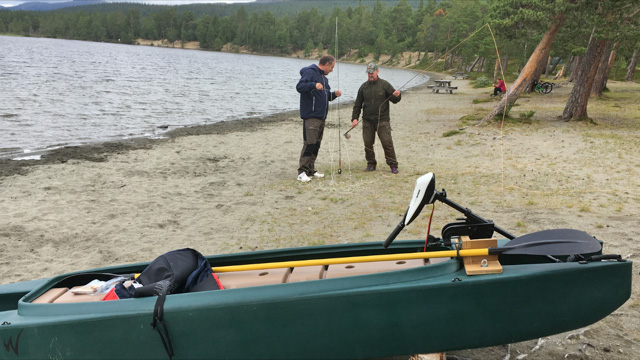
In the sense that it works well as a micro skiff, namely a small, flat bottomed boat used for fishing in flats, estuaries and protected bays, yes, a motorized Wavewalk 700 is an ultra lightweight, trailer-free micro skiff, and it can even be outfitted with a bow mounted electric trolling motor powered by a battery fed by the alternator in a small stern mounted outboard motor. This said, its form is very different.
The Wavewalk S4 is more seaworthy than other micro skiffs, as well as more versatile since it works well as a paddle craft, so unlike other microskiffs, it cannot get stranded in shallow water and ebbing tides.
* Interestingly, the crew of competition sailing catamarans has to relocate from one side of their boat to the other in order to help stabilize it.