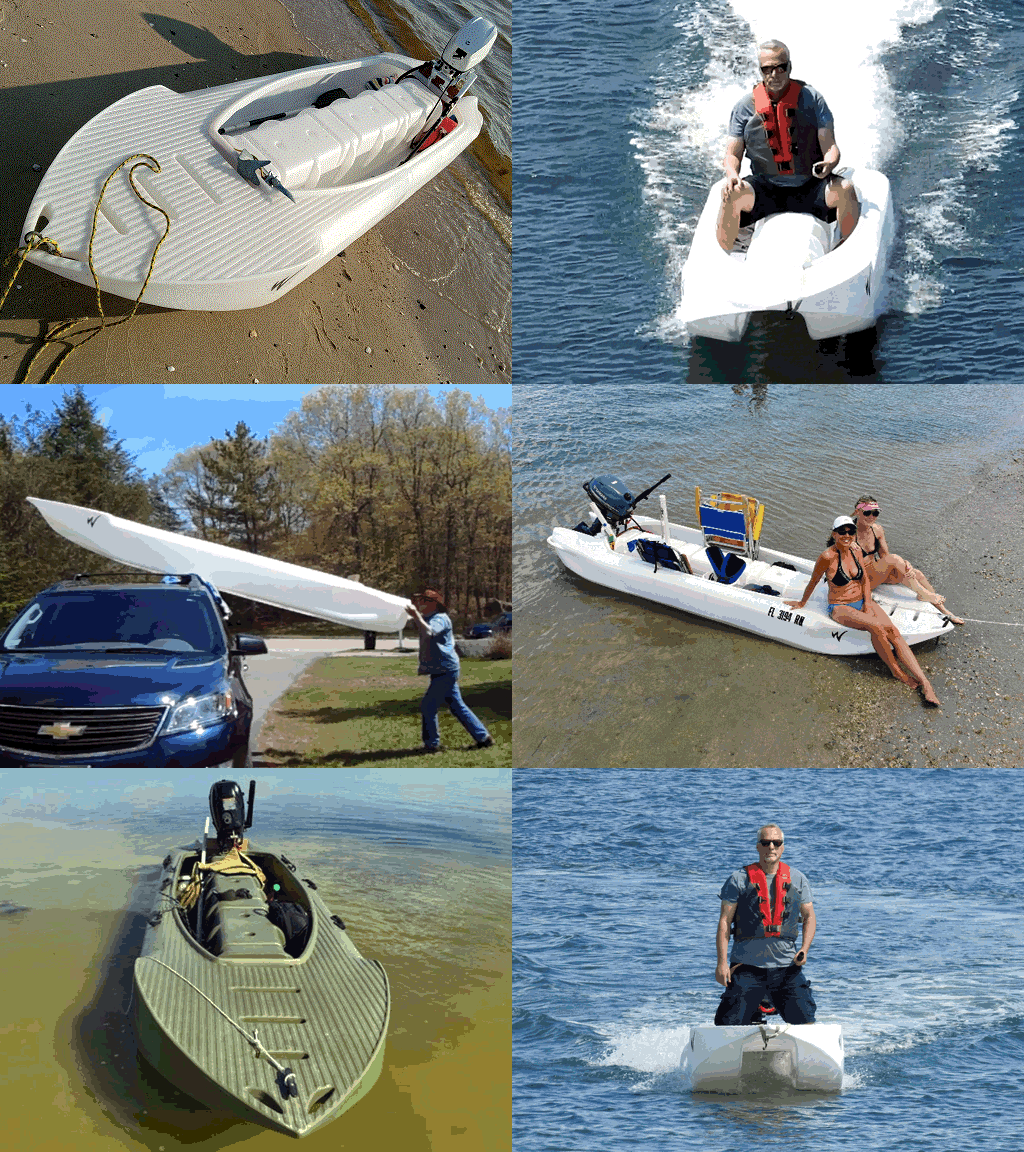
What is a Microskiff?
Microskiff Definition
A Microskiff (micro-skiff I.E. tiny skiff) is a small-size, shallow-draft, motorized fishing watercraft that features a deck and does not exceed 15 ft (5 m) in length. A microskiff can be a mono-hull motorboat, a twin-hull (catamaran) motorboat, or a large-size motorized paddle-board. The term Microskiff is not used in official watercraft classification.
Differences between Microskiff and Skiff
A microskiff is small by definition, and therefore, a Skiff is longer than 15 ft (5 m), which is the upper limit on the length of microskiffs. Due to its larger size, a Skiff can be outfitted with a tower at the stern, for sight-fishing and poling, and/or with a center console, while typical microskiffs rarely feature such deck structures, due to their small size.
Another distinction between microskiffs and skiffs is that microskiffs are powered by a single outboard motor while many large-size skiffs are powered by two outboard motors. 30 HP is the generally accepted upper limit for the power of a microskiff’s motor, and the practical limit on the power of a skiff is what the authorities in the state in which it is registered accept, as overpowering a boat is legal in some states and illegal in others.
Differences between Microskiff and Motor Kayak
Unlike microskiffs, large-size fishing Kayaks are designed primarily for human powered propulsion (I.E. paddling or pedaling), and not for motorizing. Therefore, motor kayaks offer too little stability, and their long and pointy stern prevents users from directly accessing a stern-mounted outboard motor. Both these negative factors severely restrict the power of a motor suitable for safely propelling a kayak.
The US Coast Guard (USCG) regulates the boat market and it is responsible for power rating of watercraft including kayaks. The USCG rates kayaks for up to 3 HP motors, and therefore, if a manufacturer rates a vessel for more than 3 HP, it may not classify as a kayak.
In sum, when applied correctly the term motor kayak refers to a small craft powered by a weak electric motor or an outboard gas engine up to 3 HP, while even the smallest microskiff can be powered by more a powerful motor.
Despite these clear differences, due to the nature of marketing there has always been some confusion between these two terms, with motor kayak manufacturers describing their products as exciting little microskiffs, and manufacturers of portable microskiffs and other small motorboats e.g. the Mokai (short for motor-kayak) describing their products as high-performance motor kayaks.
Microskiff Characteristics –
1. Microskiff Propulsion
A microskiff’s primary propulsion comes from a transom mounted outboard gas motor. The lightest and narrowest microskiffs are also fit for human powered propulsion with canoe, kayak, or SUP paddles, and by means of a push-pole. Some microskiffs are outfitted with an auxiliary bow-mounted electric trolling motor. More powerful electric motors can serve in no-motor zones (NMZ) and on flat water, but their usage is limited to shorter trips due to the lower energy density of batteries compared to the high energy density of gasoline.
2. Microskiff Usage
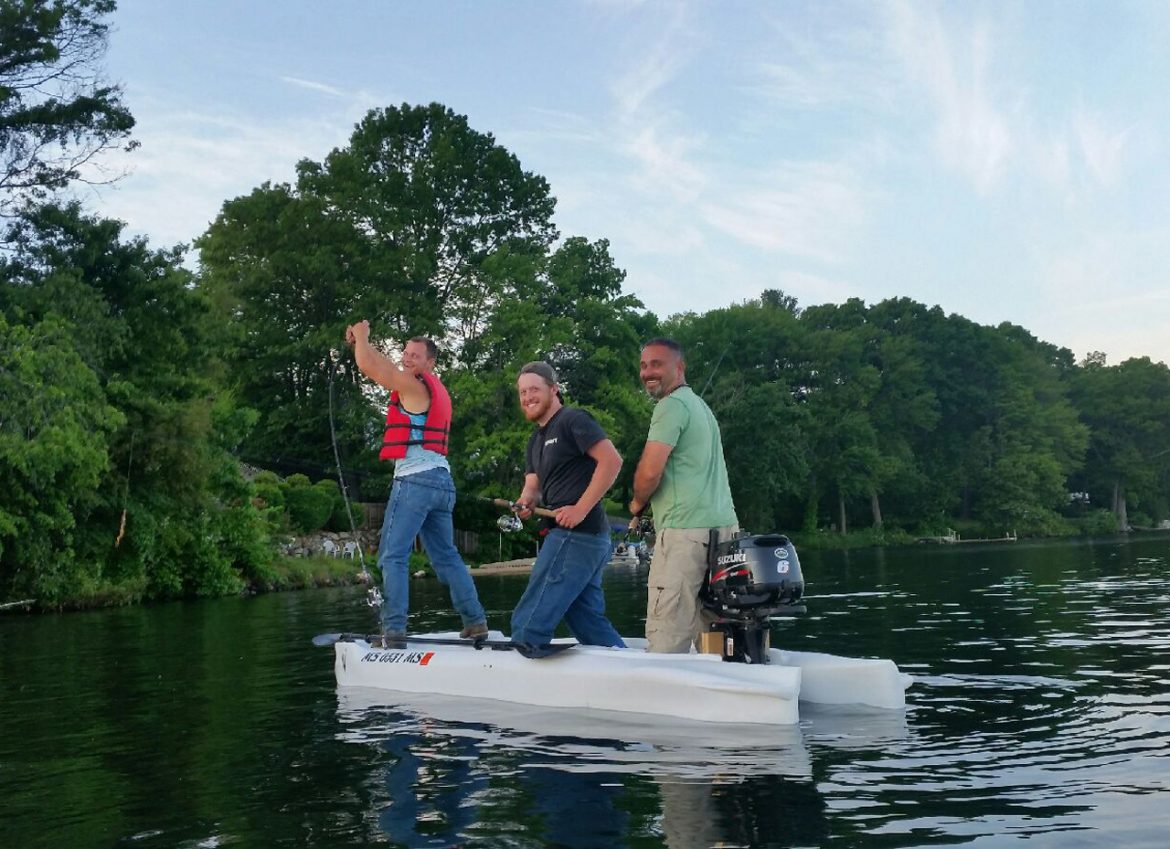
Due to their small size, microkiffs are used mostly for fishing flat and shallow water, although some microskiffs are suitable for fishing in the ocean, primarily in protected bays and estuaries. Depending on its type, design and size, a microskiff is expected to be stable enough to enable between 1-3 anglers to stand up and fish comfortably in this position, even in choppy water. Micrsokiffs are also used for shrimping, crabbing, lobster fishing and oyster fishing, as well as spearfishing.
3. Types of Microskiffs
The traditional microskiff is a flat-bottomed, shallow-draft mono-hull, fiberglass motorboat for fishing flat and shallow water, which must be transported by trailer. Some mono-hull microskiffs feature a V-hull, which enables their users to fish in bays and estuaries.
Another type of microskiff resembles a large-size paddle board. These microskiffs feature either a rigid, thin-walled hull filled with closed-cell foam, or an inflatable hull. Paddle-board style microskiffs offer very little to no free board, which can be a problem when driving them in waves. Many of them are outfitted with a leaning-bar (grab-bar) designed for their users to hold while driving or fishing in order to compensate for the craft’s poor stability. The effect of such leaning bars is mostly psychological, I.E. subjective, and not necessarily anchored in physics or ergonomics.
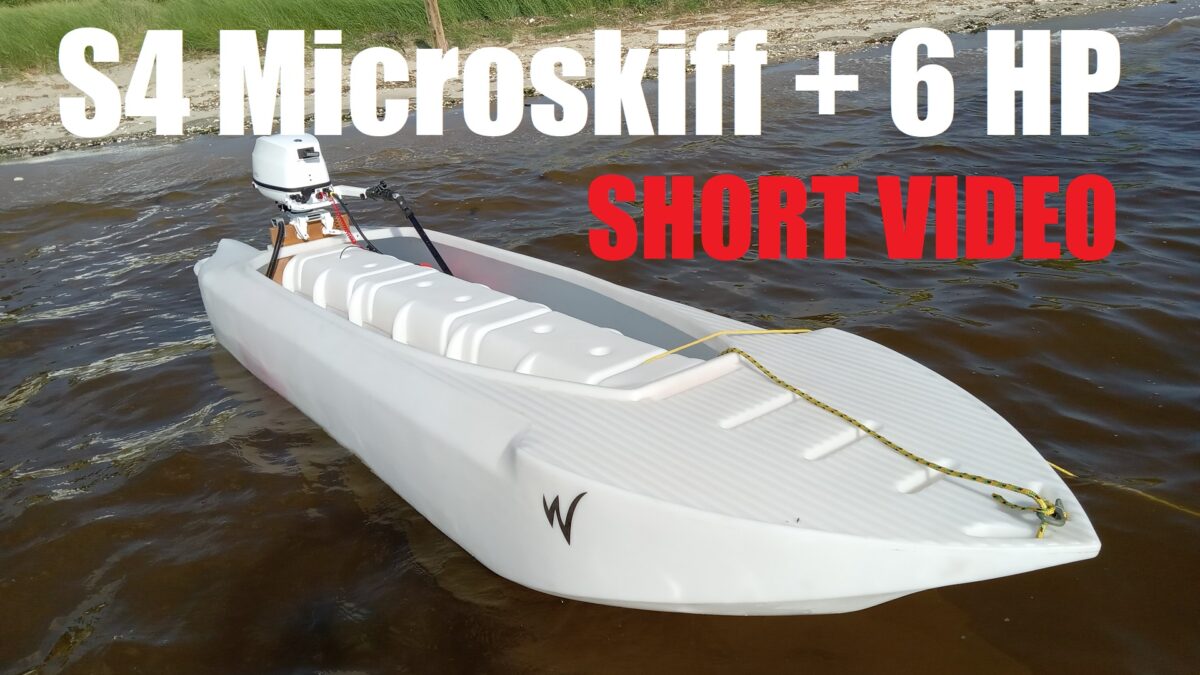
A third type of microskiff is a twin-hull (catamaran) boat, such as the seaworthy car-topper S4 Microksiff.
4. Microskiff Design
Traditional mono-hulled microskiffs designed for flat water fishing feature a flat bottom, while those designed for fishing in moving water and in the ocean feature a deep V-hull.
In principle, paddle-board style microskiffs are designed for fishing in moving water and waves, but since their users must stand on top of a narrow and slippery deck located several inches above waterline, their actual performance in such conditions doesn’t necessarily meet their stated performance, due to insufficient stability. To compensate for this shortcoming, most of these craft feature a leaning bar, but there is doubt whether such accessory offers more than a mere psychological effect on its user.
The S4 Microskiff is a patented, seaworthy, twin-hulled (catamaran) portable microskiff. The S4 is rated for 6 HP motors and officially classified as a multi-hull boat according to US Coast Guard (USCG) regulations.
The new S4 Duo is an innovative boat that’s easily assembled from two S4 Microskiffs strapped together, and it can be used either as a full-size boat or as two separate S4 Micrsokiffs.
Microskiffs feature a deck, which is the main difference between them and Jon boats (sometime called John boats), in which the users stand on the bottom of the hull. A Jon boat outfitted with a deck fits the description of a micrsokiff. Jon boats are traditionally made from aluminum, and microskiffs are usually made from various types of polymer resin (plastic) or fiber-reinforced resin (FRP), typically fiberglass.
5. Microskiff Transportation
In general, a microskiff requires transportation on a boat trailer, and therefore it must be launched from a boat ramp, in most cases, which is inconvenient and costly in terms of time.
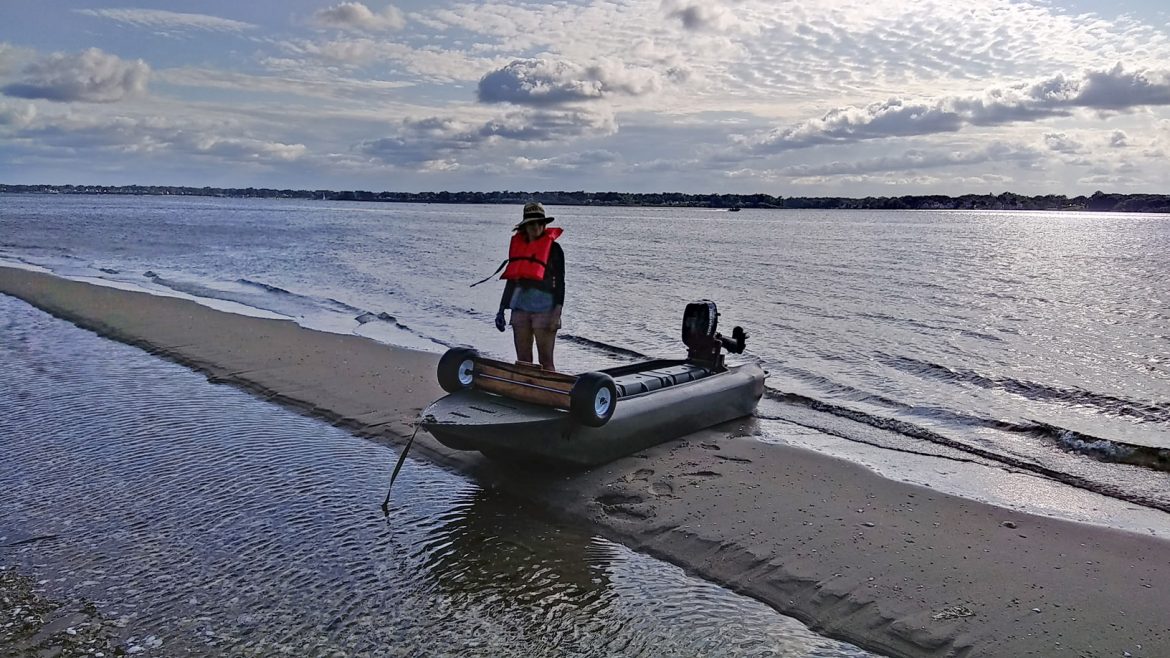
A portable micrsokiff may be pulled by hand over short distances, usually on a small wheel cart, and uploaded on the truck bed of a pickup truck. Portable microskiffs can be launched from many beaches, and their owners depend far less on boat ramps for access to water.
A portable micrsokiff that’s lightweight enough for one person to haul on top of the roof of their vehicle is called a car-topper microskiff and it can be launched nearly anywhere –
Some paddle-board style microskiffs are portable, and the lightest microskiff, which is Wavewalk’s 100 lbs (45 kg) twin-hull S4 Microskiff, is a car-topper.
6. microskiffs’ price and cost of ownership
Microskiffs range in price between $2,000 and $20,000. The typical microskiff is a fiberglass boat that costs $10,000 on average without the trailer required to transport it and without the motor.
Traditional microskiffs require some maintenance in the form of cleaning and painting their hull, but overall, their cost of maintenance is low, and portable microskiffs are maintenance free.
Background –
1. A brief history of the Portable Microskiff
Microskiffs trace their origins to motorized dinghies, square stern motorized canoes, Jon boats, and flat bottomed southern boats named pirogues.
Portable micrsokiffs entered the market later than traditional micrsoskiffs did. The term Microskiff appeared sometime during the second part of the first decade of this century. From the start, it wasn’t clearly defined, and since then many anglers have been unable to make a clear difference between microskiffs and full-size skiffs. There were no portable microskiffs back then.
This was the time of the popular kayak fishing revolution, which consisted mainly of anglers transitioning from fishing out of canoes and dinghies to fishing from kayaks, mostly sit-on-top (SOT) kayaks. The main attraction in kayaks was their small size and light weight, which made them easy to carry and car-top. The kayak fishing phenomenon led to the creation of hundreds of kayak fishing websites, online forums, clubs, and tournaments. Dozens of kayak manufacturers entered this expanding market. Back then, the big discussion was about pedal-driven kayaks, and few people motorized their fishing kayaks. Some kayak fishing ‘purists’ believed that a kayak with a motor may no longer be considered as a kayak. In general, manufacturers avoided offering motorized kayaks.
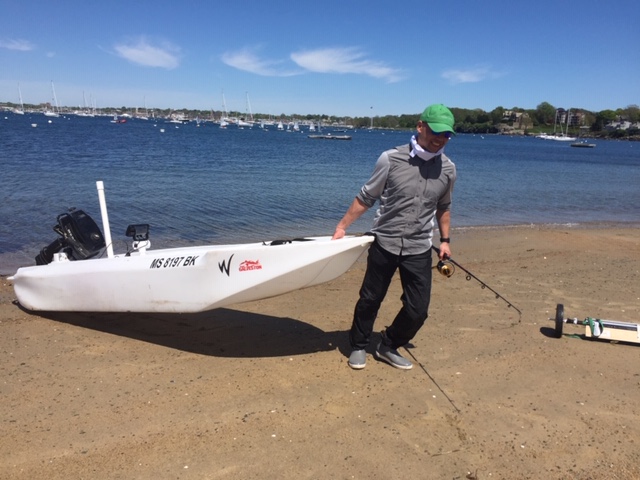
Starting in 2009, an increasing number of the popular Wavewalk 500 (W500) kayak owners experimented in motorizing it, mostly with electric motors. The first significant breakthrough occurred in South Korea, when Sungjin Kim successfully outfitted his W500 with a 2.3 HP Honda gas outboard. A few years later, Kenny Tracey successfully demonstrated that it was possible to drive a W500 powered by a 6 HP Tohatsu outboard motor, and the gap between fishing kayaks and portable fishing motorboats began to close. In other words, the portable microskiff concept was beginning to take shape.
Wavewalk produced many demo videos showing its W500 kayak driven with 2.3 HP and 6 HP motors, and those videos were well accepted by anglers. In the early 2010s, a boat designer from Florida came up with the first paddle-board style microskiff that he named Soloskiff, that is a skiff for one person. That boat was made from fiberglass, and therefore too heavy to be portable.
Wavewalk participated in the ICAST 2016 trade show, where it exhibited its new 75 lbs W700 Kayak-Skiff, a bigger version of the W500 that was designed with motorizing in mind. In other words, it was still more of a motor kayak than a boat or a microskiff.
In the same event, a roto-molded Polyethylene Soloskiff was revealed to the public. It was an elegant, portable microskiff that weighed 150 lbs (68 kg), and it was promoted as a “Kayak On Steroids, with “Forget About Paddling” as its motto. Its manufacturer targeted the larger and therefore more promising kayak fishing market rather than the micrsokiff market. The Soloskiff was priced right and marketed masterfully, and it made a big splash that lasted a couple of years. Eventually, the public became aware of its performance shortcomings, which were mostly its excessive weight, poor ergonomics, and lackluster stability, which have been plaguing all paddle-board style microskiffs since then.
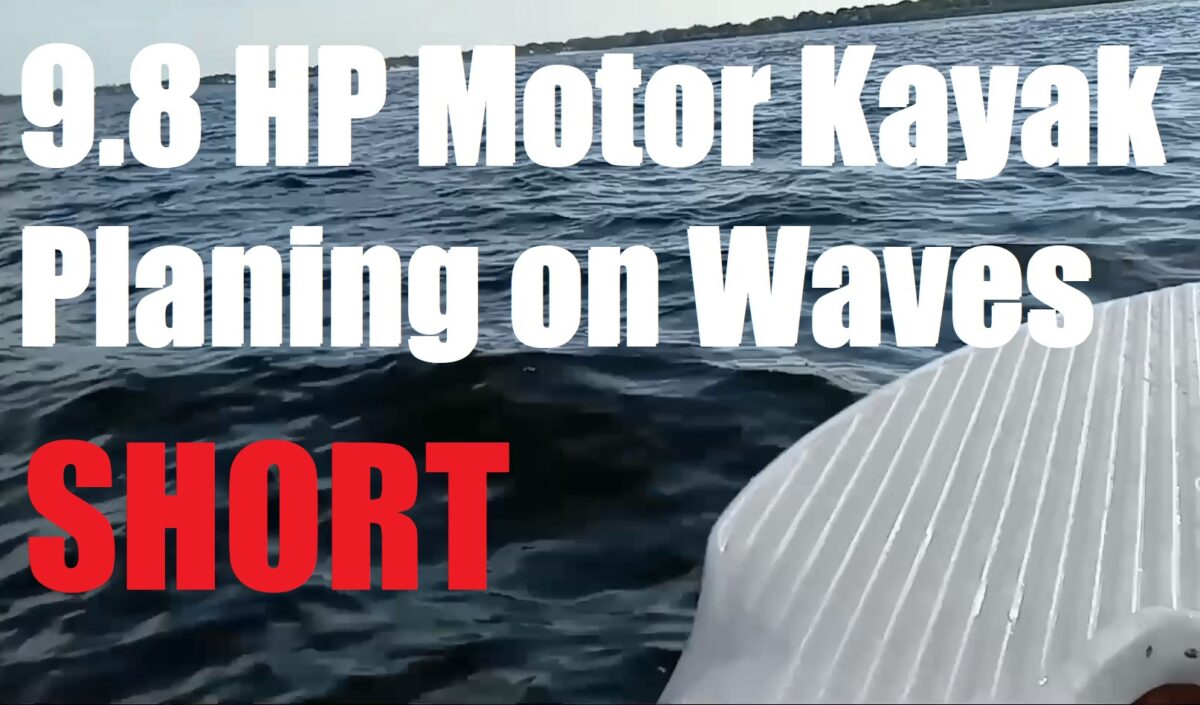
The W700 became a success as well, to a point where it had almost completely cannibalized its predecessor, the W500. The W700’s success prompted Wavewalk to come up with the S4 Microskiff, its full-fledged microskiff featuring a casting deck. The S4 is rated for a 6 HP outboard motor but some owners outfit it with motors up to 9.9 HP. Unlike the heavier portable micrsokiffs, the S4 weighs only 100 lbs (45 kg), that is no more than a large-size fishing kayak, which makes it a car-topper. The S4 is seaworthy thanks to the combination of its light weight and its ergonomic design enabling its users to balance themselves and control their boat simply and effectively in waves up to 2 ft.
2. Portable microskiffs in recent years
Paddle-boards are relatively easy to manufacture, and over the years many manufacturers have introduced copycat versions of the Soloskiff, including several inflatable portable microskiffs with similar designs.
Wavewalk launched the S4 Microskiff in 2017, and it is still unrivaled in every aspect that made it a sensation back then. No one has been able to come up with a boat that offers anything close to the S4 performance.
The S4 Microskiff is produced in Latta, South Carolina, and it is shipped from there to clients in the US and Canada, and in other countries.
The New S4 Duo is a breakthrough in boating and therefore hard to classify. It can be propelled by two outboards, which makes it a skiff and not just a microskiff, but due to the fact that it is a car-topper boat, it makes more sense to classify it is a microskiff.
3. traditional microskiffs in recent years
Interestingly, while the field of portable microskiffs has evolved significantly over the past two decades, there has been little change in traditional microskiffs, and the only noteworthy innovation in this field has been the 382 lbs (I.E. not portable), 13 ft long, expensive roto-molded polyethylene Veer V13, described as a “Microskiff Jon-boat”.
Polyethylene offers important advantages over fiberglass, notably its durability and resilience, which made it the material of choice for kayaks of all types, as well as the Soloskiff, Wavewalk’s W720 Kayak-Skiff, and the S4 Microskiff.